
Another baseball season has begun and the main topic of discussion has been the rise in pitching injuries. Notable pitchers falling to injury so far this year include:
- Eury Pérez, Miami Marlins – out for the season, UCL tear.
- Shane Bieber, Cleveland Guardians – out for the season, elbow injury.
- Spencer Strider, Atlanta Braves – out for season, elbow injury
- Gerrit Cole, New York Yankees – out until June, nerve inflammation in his pitching elbow
- Framber Valdez, Houston Astros – out indefinitely, elbow
These are just the most notable pitchers but on opening day, there were 132 on the injured list (IL). In total, there were 166 players on the IL on opening day, so pitchers made up 79.5% of those injuries. As of this posting, there were now 156 pitchers on the IL. Our math then indicates that exactly 20% of just pitchers of all MLB rosters are currently on the IL!
Overall, there is no agreement on exactly why pitching injuries are on the rise, but you will get a different answer depending upon whom you ask. The players’ side as represented by their head Tony Clark states:
“Despite unanimous player opposition and significant concerns regarding health and safety, the Commissioner’s Office reduced the length of the pitch clock last December just one season removed from imposing the most significant rule change in decades.
Since then, our concerns about the health impacts of reduced recovery time have only intensified.
The league’s unwillingness thus far to acknowledge or study the effects of these profound change is an unprecedented threat to our game and its most valuable asset — the players”.
On the other side, the league pushed back on Tony Clark’s statement by issuing the following response: “This statement ignores the empirical evidence and much more significant long-term trend, over multiple decades, of velocity and spin increases that are highly correlated with arm injuries. Nobody wants to see pitchers get hurt in this game, which is why MLB is currently undergoing a significant comprehensive research study into the causes of this long-term increase, interviewing prominent medical experts across baseball which to date has been consistent with an independent analysis by Johns Hopkins University that found no evidence to support that the introduction of the pitch clock has increased injuries. In fact, JHU found no evidence that pitchers who worked quickly in 2023 were more likely to sustain an injury than those who worked less quickly on average. JHU also found no evidence that pitchers who sped up their pace were more likely to sustain an injury than those who did not.”

The alarming increase in the breakdown of pitchers has though prompted MLB to perform a full in depth study to review the problem to determine its root causes and potential recommendations as quoted here:
According to an MLB source, the league is conducting a comprehensive study of pitcher injuries. This ongoing deep dive, which began last October, has consisted of data analysis and approximately 100 interviews with informed figures, including doctors, trainers, independent researchers, college coaches, amateur baseball coaches and stakeholders, former pitchers, front-office members, pitching coaches, and current players. The study’s end date is still underdetermined; for now, the league is following leads as they develop, and each conversation tends to spark a few more. When the study does conclude, though—possibly later this year—the league intends to form a task force that will make recommendations for protecting pitchers and, in the process, restoring some of the starter’s lost luster.
Keep in mind that the issue with pitching injuries is a trend that did not just arise recently, but one that has continued to increase over many years. This analytic study from 1998 – 2015 clearly shows the increasing breakdown of pitchers over that period.
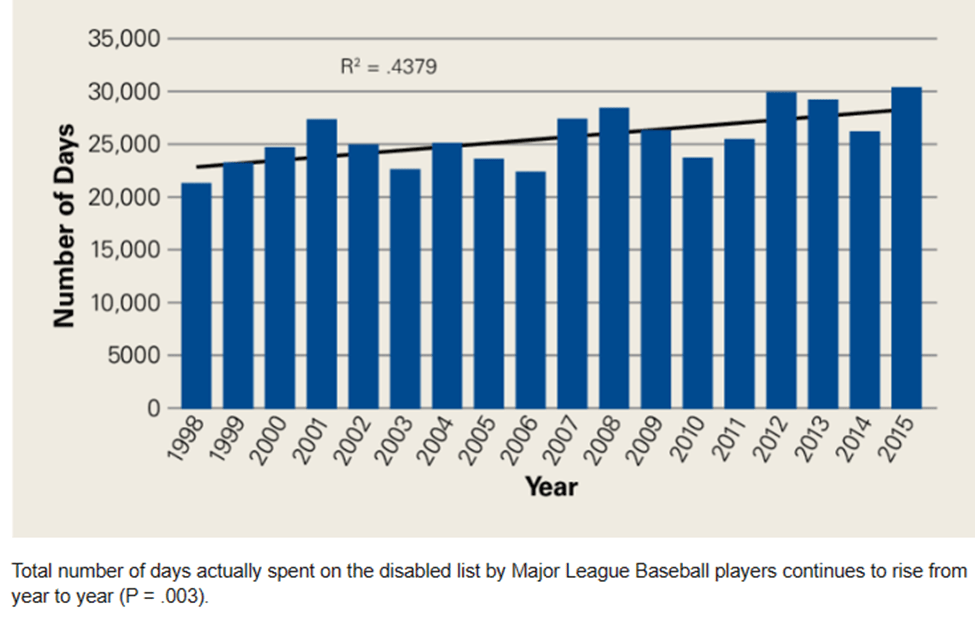
It is clear the increasing rate in pitcher injuries is obviously a long-standing issue, so even we here at BP will not suggest that the implementation of the pitch clock is the sole reason for the problems faced today. It is though unacceptable to simply dismiss the pitch clock as a non-factor in the rise in injuries.
If we delve into the implementation of the pitch clock, we note that last year was the first year that MLB adopted this major rule’s change. Prior to that, the Minor Leagues (MiLB) adopted their similar pitch clock rules a year earlier in 2022. Therefore, there is only data for the past two years for MiLB and one year for MLB while working under the pitch clock. These rule changes might likely take some time to evaluate in terms of the impact they have on pitchers bodies. Instead, MLB should have waited to gather further data over multiple seasons to determine the long-term effects of the pitch clock on pitchers in the MiLB before instituting the rule in MLB.
Here at BP we raised the concern of how the lack of rest during a game could negatively affect a pitcher’s arm over a year ago in one of our earlier posts titled Faster Game vs More Injuries. In addition, Max Scherzer who is undoubtedly not a fan of the pitch clock, but did link his concerns about the pitch clock to not necessarily the number of injuries, but an increase in the severity in this interview this past November with the Foul Territory podcast. In this interview with Scherzer he notes that his observations are not his own, but those of the two top surgeons in the game Dr. Keith Meister and Dr. Neal ElAttrache. In the interview Scherzer states “when you actually talk to Keith (Meister) and having conversations with him, he saw that the elbow injuries this year (2023) are way more severe. If you look at all the data the pitcher injuries are at the high end, but you have seen high end numbers, but it is the severity of the injuries that are much more problematic as per Keith (as noted by Dr. Meister). He (Keith) talk to Neal ElAttrache another renowned surgeon within the game and both of them are seeing the same thing in the game, which is an uptick in the severity”.
What is infuriating Scherzer is beyond the original pitch clock rules, but the fact that MLB decided to quicken the pace even further by shortening the time pitchers have to deliver their throws in 18 seconds from the original 20-second limit with runners on base. Scherzer argues against implementing an even faster pace for what would be likely just an overall 5-minute time savings per game, especially since no one has determined how a pitchers’ health has been impacted from the original pitch clock rules. Good question Max, and obviously the ones that the MLB hierarchy should have been asking.
Note that our BP coverage and our thoughts on the implementation on this latest pitch clock rule was in our post titled So Little Time earlier this year, which somewhat echoes the concerns raised by Scherzer.
Overall, MLB hierarchy knew pitcher injuries were mounting many years ago and the data clearly supports that statement. Rule changes like the pitch clock and to a lesser degree, those that require pitchers to face a minimum number of batters, only placed more stress on their bodies. It is hard to imagine based upon prior knowledge how anyone could surmise that requiring pitchers to put more stress on their bodies would not affect the mounting injury count. Based on statements though by MLB they seem to want to deflect or minimize any criticism of the pitch clock. In our opinion though, such criticism is warranted, since there obviously has not been enough study on the impacts of the rules change. In addition, there have been members of the medical community who have voiced their concerns of the pitch clock on pitchers’ health.
Again, we are not suggesting that pitch clocks alone created MLB’s current dilemma but implementing this rule change without basing their decision on any prior studies leaves us to doubt their current position. Based on MLB’s previous actions and stances, we very much doubt their objectivity when it comes to the study they commissioned and implementing corrections to safeguard the safety of today’s pitchers. Ultimately, we strongly believe that MLB will never decide that the pitch clock or slowing the game down as a remedy to the current issues. Prove us wrong MLB!


 Baseball Purist
Leave a comment