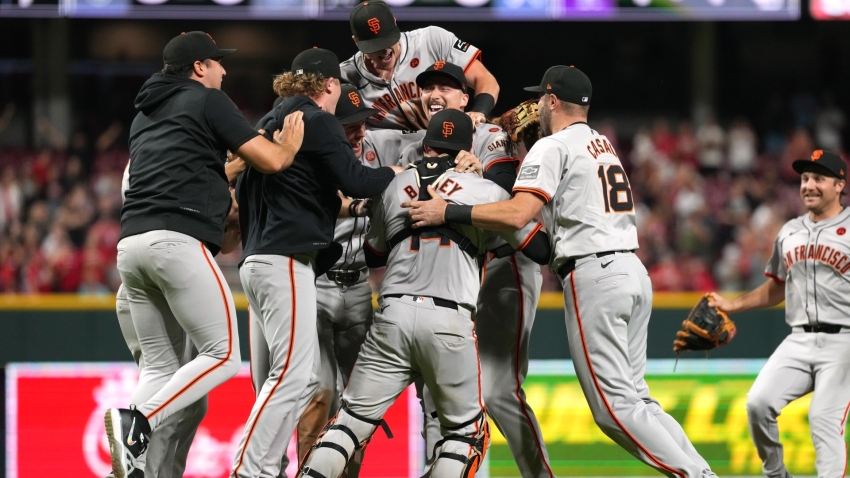
For 90 years from 1876 through 1966, major league baseball only had one combined no-hitter meaning more than one pitcher was involved in the effort. Overall, there have been 20 combined no-hitters in major league history. Although a combined no-hitter was a rarity prior to 1970 (there were only two) it has become commonplace recently. Nine combined no-hitters have taken place between 2018 and 2023, which accounts for almost half of all the combined no-hitters. Overall, there has been 325 no-hitters in the history of major league baseball, with 24 perfect games.
That trend of increased rates of combined no-hitters in recent years is not that shocking considering complete games in general are pretty much a thing of the past. We will explore the extinction of the complete games in another post, but suffice to say that the emergence of relievers and later on the implementation of analytics has nearly wiped out the complete game from MLB.
Another interesting statistic is that since 1893 there have been 33 instances of a pitcher throwing at least seven hitless innings in a game but not completing the game. Twenty-three of those instances occurred within the past 10 years, which again reflects the emphasis on analytics and pitch counts. Note that the first instance of pitchers not completing a game after pitching at least seven innings did not occur until 1956, so the first 63 of years of baseball did not even have such an occurrence.
Visually, this graph shows by decade (since 1950) the number of pitchers who pitched at least seven innings before leaving a no-hitter intact.
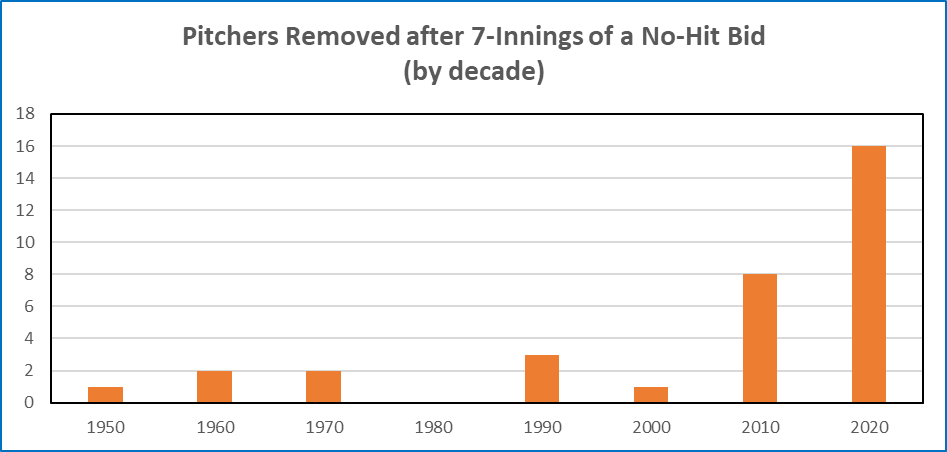
What this means is that clearly the game has changed since 2010, with combined no-hitters way up and complete game no-hitters down. The culprit is analytics as teams keep pitchers on closely monitored pitch counts, even when pitchers are in the midst of a non-hitter. It used to have been unthinkable to remove a pitcher from a game when pitching a no-no, but now that has become more of the norm than the exception. Ultimately, pitch counts rule.
Ironically, all three no-hitters pitched so far in 2024 have been complete games. The last one came from an unlikely candidate in the person of Blake Snell of the San Francisco Giants. Not unlikely in the fact that Snell is not someone who had the talent to pitch a no-hitter, but more surprising in the fact that his August 2nd no-hitter was not just his first, but incredibly it was his first complete game of his career. Snell has been in the league since 2016 and pitched for three different teams for 1,049.1 innings pitched and in his 202 game of his career he picked up not just his first no-hitter, but his first complete game. Maybe this game for Snell says more about the game than it does about him in this day and age of baseball.
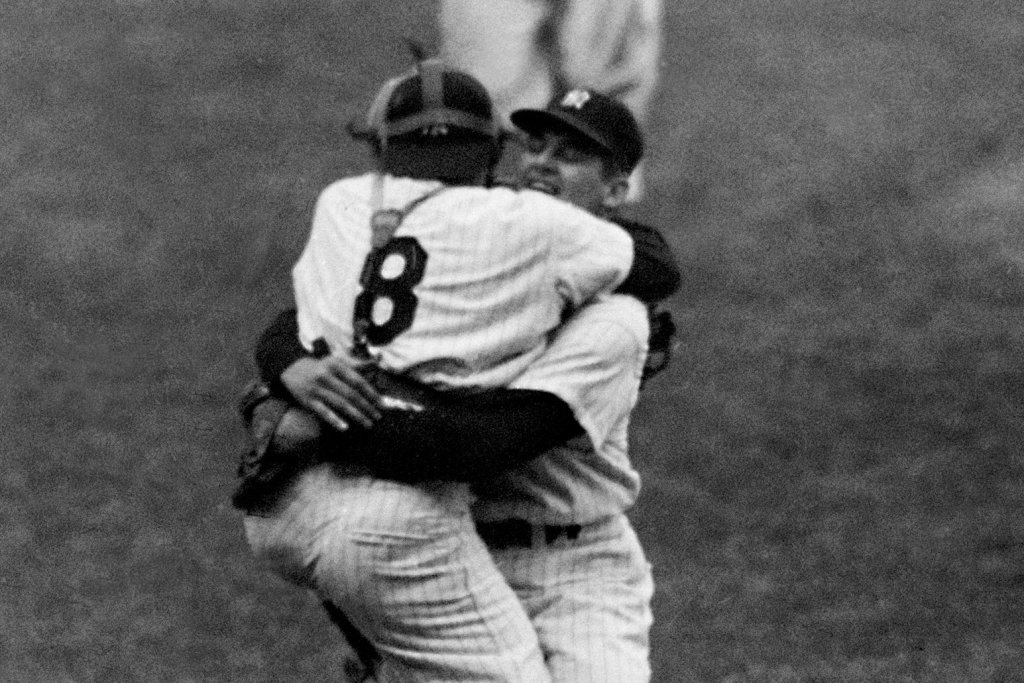
From a non-analytic perspective, we at BP believe there is something inherently satisfying for cheering on your team’s starting pitcher in a complete game no-hitter as opposed to having multiple pitchers involved in such an effort. We must admit that many fans are okay with the current trend as there are differing opinions on this topic as noted in this Reddit thread.
Overall, it is an interesting argument. On the pro side for completing games is that a pitcher has earned his right to complete and finish a historic feat in his career. If someone is going to give up the first hit, rather it be the starting pitcher, who began the effort. On the con side are pitch counts and the strain on pitchers arms. Pitchers nowadays are limited to normally no more than 100 pitchers and one reason cited is how hard today’s hurlers throw, so the risk to injury outweighs the self-glory of one outing.
Compelling arguments from both sides. We prefer the pro side as noted previously, but understand the change in the landscape due to analytics. In the big picture of what we cover here at BP, the question is that maybe all this emphasis on pitch clocks and the length of game is misguided, and rather other factors are working to remove interest in the game. Perhaps a no-hitter completed by five pitchers, is not as compelling to the average fan as one starting pitcher. Again, something to think about in the big picture as MLB struggles to redefine the game for today’s fandom.

 Baseball Purist
Leave a comment