NOTE: This will be a two part post with the second half released next week.
By Bill Coleman
Inside the Vintage Base Ball Association—and the remarkable movement bringing the 19th century’s game back to life
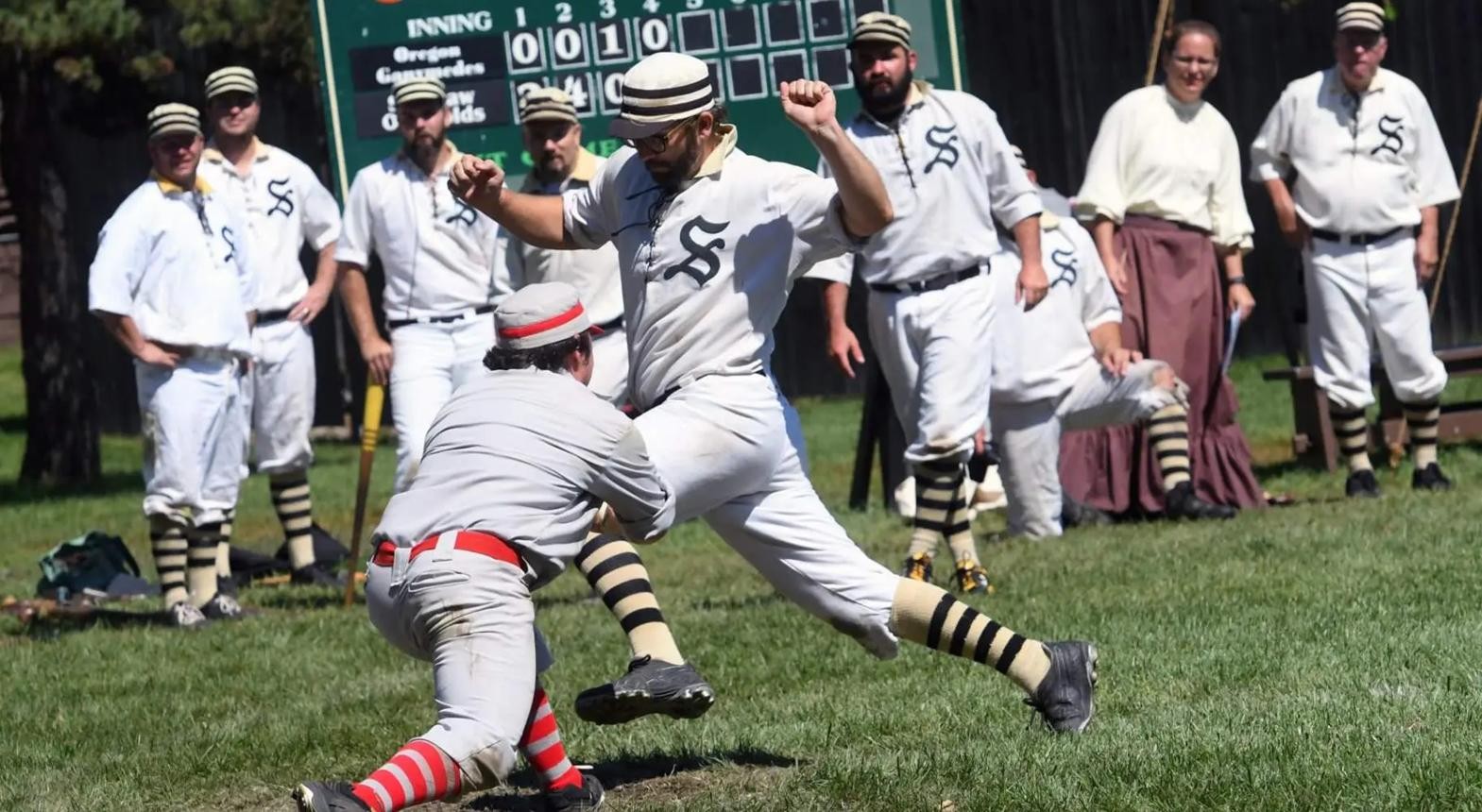
On a summer afternoon, the baseball field looks almost right. There are nine men in the field, a batter waits at home plate and a pitcher stands 45 feet away. Spectators gather along the foul lines. Bats crack against baseballs, runners race around the bases and an umpire, often called an “umpire” or “referee,” depending upon the era being portrayed, makes the calls. Something though is unmistakably different.
There are no gloves. The pitcher delivers the ball underhand. The uniforms look as though they have walked straight out of an old photograph. The baseball is larger and heavier than the modern ball. The terminology is different. When a sharply hit grounder comes screaming toward a fielder, nobody reaches into a leather glove. He reaches out with his bare hand.
Welcome to the world of the Vintage Base Ball Association (VBBA), where baseball is not simply watched or studied, rather it is re-created. The Association’s mission is to preserve, perpetuate and promote baseball as it was played during its formative years in the 19th century and other historic eras. Its member clubs attempt to reproduce not only the rules, but also the uniforms, equipment, field specifications, customs, language and behavior of the period. The result is one of the most fascinating and wonderfully eccentric ways to experience baseball history.
A Game That Refuses to Stay in a Museum
The Vintage Base Ball Association (VBBA) was formally established on February 11th, 1996, when delegates representing 13 clubs from five states met in Columbus, Ohio. Their inspiration was the National Association of Base Ball Players, the organization that helped standardize the game during the 19th century.
The timing was deliberate, since 1996 marked the 150th anniversary of the famous 1846 contest between the New York Knickerbockers and New York Nine that is commonly recognized as the first recorded game played under the Knickerbockers’ formal rules. Nearly 30 years later, the VBBA has become a nationwide network of clubs devoted to bringing those formative years back to life. Vintage base ball is now played in more than 20 states as well as Canada, with games taking place at museums, living-history villages, Civil War events and ordinary city parks. In other words, the 19th century never completely went away. It just moved to another ball field.

Forget the Gloves

For a modern baseball fan, the first real and obvious difference is the equipment since this version of the game does not utilize gloves in the field. In addition, depending upon the historical year portrayed, players use period-style balls and wooden bats, while catchers can find themselves facing pitches without the protective equipment modern players use nowadays. The differences are not cosmetic. The rules themselves can transform the sport.
Under the 1860s rules, for example, a batted ball caught after one bounce could count as an out in certain seasons. By the mid-1860s though, the rules had evolved so that the first-bound catch was generally eliminated except for foul balls. In addition, the baseball itself was different. The VBBA’s interpretations of the 1860 rules call for a ball considerably larger and heavier than today’s baseball, constructed with rubber, yarn and leather.
Imagine if you were playing shortstop with no glove and knowing that a ball coming at you might be considerably different from the baseball that you are accustomed. Suddenly, fielding becomes an act of courage.
The Pitcher Isn’t Standing on a Mound

One of the most visually striking differences is the pitcher. The modern pitching motion evolved dramatically during the 19th century. Vintage clubs playing according to earlier rules generally use an underhand delivery, rather than today’s overhand pitching. And there isn’t necessarily a pitcher’s mound. Under some 1860s rules, the hurler’s position was just a line approximately 45 feet from home plate. That radically changes the geometry of the game. There is no 60 feet, 6 inches, no raised mound and no 95-mph fastball.
Overall, the pitcher is closer, the delivery is different and the relationship between pitcher and batter feels more like a contest of skill and strategy than the power oriented confrontation familiar to today’s fans. The VBBA maintains historical rule interpretations specifically to help clubs reproduce these differences accurately.
They Don’t Just Play the Game. They Reconstruct It.
The most impressive aspect and objective of the VBBA is not simply to make baseball look old-fashioned, but rather to recreate the accuracy of this bygone game. The Association’s Rules and Customs Committee conducts historical research into the way the game was actually played including uniforms, equipment, customs and conventions and makes that information available to member clubs. That means the players are not merely dressing up, they are also researching the game as well.
A club portraying an 1860s team might study period newspapers, rule books, photographs and instructional manuals. The VBBA makes historic rule books available, including editions of Beadle’s Dime Base-Ball Player, which first appeared in 1860 and which was published annually through 1881. It served as a living history of the game back then, but with a box score.

“Striker,” “Hurler” and the Language of Baseball
Even the language matters. A batter may be a “striker.” A pitcher can be a “hurler.” Fans may be “kranks.” The terminology is not merely theatrical, but rather it is part of the educational mission.
The VBBA explicitly emphasizes that spectators should be able to trust what they are seeing and hearing. The goal, according to the Association’s own historical guidance, is to re-live history rather than rewrite it. That philosophy separates vintage base ball from a simple costume event. The players are not pretending to be 19th-century baseball players. For a few hours, they are trying to understand what it was actually like to be one while immersing themselves in a competitive game.

Even Sliding Was Different
Here is something modern baseball fans might not expect: Sliding existed in the 19th century, but not necessarily the way we know it now. The VBBA’s interpretation of 1860 play notes that sliding was practiced, but the familiar modern foot-first slide was not typical. Instead, runners generally approached the base hands first, attempting to grab the strap around the base. It is a tiny historical detail, but reveals the philosophy behind the entire movement. The goal is not merely to recreate the appearance of old baseball, but instead to recreate the experience.

See the second half of this post next week.