Whatever happened to the player manager in baseball? The short answer is that it went away completely.
A player manager was an active player on a team that also served as the manager of that same team. During the dawn of baseball the player manager model dominated the baseball landscape. For example, in 1871, which was the first year of organized baseball known as the National Association (later to become the National League) player managers comprised ten of the eleven manager positions in the league. The model continued to flourish throughout the early 1900’s and late into the 1930’s, but beginning during WWII there was a noticeable downturn in the use of player managers. By the 1940’s that usage dropped to just three or four managers in the league. The concept continued until 1956, which was the very first year in league history that saw not one player manager.
To put that in percentages of how baseball has evolved, from 1871 through 1955, player-managers comprised 41% of all managerial positions in professional baseball across seven different leagues (the American Association, the American League, the Federal League, the National Association, the National League, the Players’ League, and the United Association). After 1955, the player manager has become a rarity with that model only comprising 0.6% of all managerial positions.
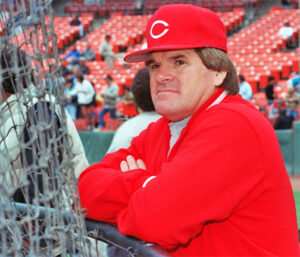
The player manager has only been seen in ten seasons since 1956 and the last player manager was Pete Rose for the Cincinnati Reds in the National League from 1984 through 1986. Rose retired as a player after the 1986 campaign, but did continue on as manager through the 1989 season for the Reds.
The last player manager in the American League was Don Kessinger back in 1979 for the Chicago White Sox. Ironically, although Kessinger only lasted as manager for one year, he did manage in one of the wildest nights in baseball history, which we previously covered in our recent post titled Wild Pitches Baseball Stadium Promotional Nights Gone Wrong: Disco Demolition.

If you look at the players that have served as player managers one thing readily jumps out at you. The vast majority were either great players or even Hall of Famers. In addition to Rose, other noteworthy players were Bill Terry, Tris Speaker, Rogers Hornsby, Leo Durocher, Joe Cronin, Mel Ott and Lou Boudreau. This is quite literally an all-star team of player managers.

Some of these player managers did achieve the ultimate success with the following winning the World Series while in their position of player manager:
| Player Manager | Team | Year(s) of World Series Win |
| Frank Chance | Chicago Cubs | 1907, 1908 |
| Bill Terry | New York Giants | 1933 |
| Fred Clarke | Pittsburgh Pirates | 1909 |
| Jimmy Collins | Boston Americans | 1903 |
| Tris Speaker | Cleveland Indians | 1920 |
| Rogers Hornsby | St. Louis Cardinals | 1926 |
| Jake Stahl | Boston Red Sox | 1912 |
| Fielder Jones | Chicago White Sox | 1906 |
| Lou Boudreau | Cleveland Indians | 1948 |
| Bill Carrigan | Boston Red Sox | 1915, 1916 |
In the early days of baseball there were benefits for using the player manager concept such as:
- It was cheaper to give a player a bit more salary to take on the manager role, which saved the owners money.
- As a player, a manager might obtain tactical insights while playing in the field that a bench manager might not detect.
- Potentially, a player manager might reap a better relationship with his players and increase camaraderie as opposed to a bench manager who was seen more as management.
Despite those perceived advantages, the likely reason for the disappearance of the player manager has been the increased complexity of today’s game. In a game now largely driven by analytics and coaching staffs that have grown by leaps and bounds over just what was once a hitting and pitching coach, it does not seem reasonable for a manager to adequately handle his off field duties while also playing in the field. Thus it is no wonder that the game has not seen a player manager in 40 years, and possibly will never see one again.

Analytics
For an excellent and deep analysis of the player manager concept, see this paper published by Craig A. Depken II from UNC Charlotte. As part of that analysis it notes the following trends in terms of player managers over the history of the game.


One other point raised in the analysis related to this second chart, is that Mr. Depken II noted that, “player managers suffered a significant reduction in on-the-field production while serving the dual role of player-manager, and the negative impact increased over time”. Likely this was another reason for abandoning the player manager model. Another possible reason for the player managers drop off in production on the field, though not raised in the article, was that many of these players took on the manager role much later on in their careers. Thus a drop in their on field performance would be expected at this point in their careers.

The table below lists a sample of player managers and notes the year in their playing career that they became a manager. We listed all the player managers previously noted, as well as the ten player managers post 1956. In the beginning of baseball’s history, players did become managers fairly early on in their careers. As time passed and especially post 1956, players only held the dual role of player manager in the twilight of their careers.
| Player Manager | Team | Playing Career | Managerial Career as Player Manager | Year in Playing Career Became Manager |
| Frank Chance | Chicago Cubs | 1898-1914 | 1905-1914 | 8 |
| Bill Terry | New York Giants | 1923-1936 | 1932-1936 | 10 |
| Fred Clarke | Pittsburgh Pirates | 1894-1915 | 1897-1915 | 4 |
| Jimmy Collins | Boston Americans | 1895-1908 | 1901-1906 | 7 |
| Tris Speaker | Cleveland Indians | 1907-1928 | 1919-1926 | 13 |
| Rogers Hornsby | St. Louis Cardinals | 1915-1937 | 1925-1937 | 11 |
| Jake Stahl | Boston Red Sox | 1903-1913 | 1905-1913 | 3 |
| Fielder Jones | Chicago White Sox | 1896-1915 | 1904-1918 | 9 |
| Lou Boudreau | Cleveland Indians | 1938-1952 | 1942-1960 | 5 |
| Bill Carrigan | Boston Red Sox | 1906-1916 | 1913-1916 | 8 |
| Mel Ott | New York Giants | 1926-1947 | 1942-1947 | 17 |
| Leo Durocher | Brooklyn Dodgers | 1925-1945 | 1939-1945 | 15 |
| Don Kessinger | Chicago White Sox | 1964-1979 | 1979 | 16 |
| Pete Rose | Cincinnati Reds | 1963-1986 | 1984-1986 | 22 |
| Joe Torre | New York Mets | 1960-1977 | 1977 | 18 |
| Solly Hemus | St. Louis Cardinals | 1949-1959 | 1959 | 11 |
| Hank Bauer | Kansas City Athletics | 1948-1961 | 1961 | 14 |
| El Tappe | Chicago Cubs | 1954-1962 | 1961-1962 | 8 |
| Frank Robinson | Cleveland Indians | 1956-1976 | 1975-1976 | 20 |
