By Bill Coleman
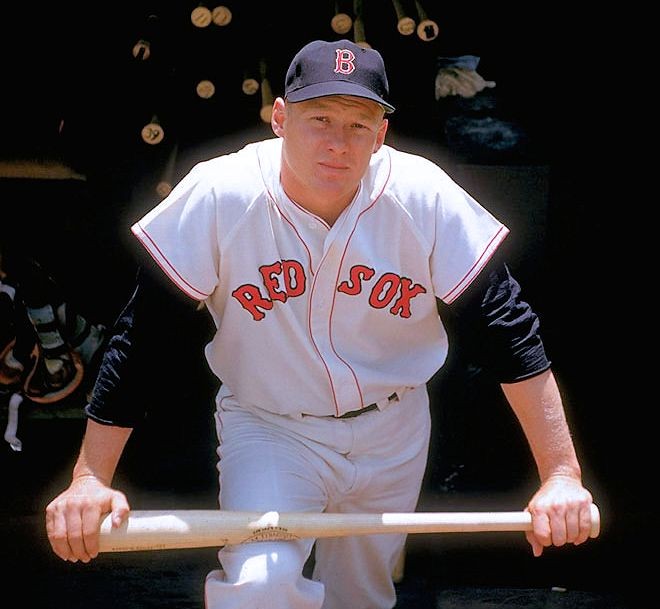
The Reluctant Star of the Red Sox
My mother grew up near Fenway Park in Boston. Back in the day, they would open the gates after the 7th inning stretch so kids could come in and watch the end of the games. So my mom would run over and sit in the bleachers to watch her favorite player…Jackie Jensen!
I even got this autographed baseball card for her one Christmas! But maybe I’m getting ahead of myself, so let’s turn back the clock!

The Rookie In the golden age of American baseball
When cross-country train rides, doubleheaders and gritty determination defined the sport—few players embodied both brilliance and vulnerability like Jackie Jensen.
He was, by any statistical measure, a star. A power-hitting outfielder with a rifle arm and a relentless motor, Jensen stood shoulder to shoulder with the game’s elite. Yet behind the accolades and All-Star selections was a man battling something far less visible: a profound fear of flying that would ultimately shape—and shorten—his career.
And What do our Friends at Wikipedia Have to Say about Him?
“Jackie played for three American League teams from 1950 to 1961, most notably the Boston Red Sox. He was named the AL’s Most Valuable Player in 1958 after hitting 35 home runs and leading the league with 122 RBIs; he also led the league in RBIs two other years, and in triples and stolen bases once each. Respected for his throwing arm, he won a Gold Glove Award and led the AL in assists and double plays twice each. Jensen was the first person to play in the Rose Bowl, the World Series and an MLB All-Star Game”
Although factual, Jensen’s Wikipedia page is essentially ubiquitous middle of the road fluff, as expected…for an unexpected gentleman…
From Golden Boy to Big League Promise
Born in California in 1927, Jensen was the prototype of the all-American athlete. At the University of California, Berkeley, he didn’t just excel—he dominated. Football, baseball, basketball—he played them all, and played them well.
His athleticism earned him early fame, and it wasn’t long before Major League Baseball came calling. Jensen debuted with the New York Yankees, a franchise loaded with legends, but opportunity was scarce in such a crowded clubhouse. It would take a move—and a bit of patience—before his true potential could shine.
Finding Greatness in Boston
Jensen’s career took flight—figuratively, if not literally—when he joined the Boston Red Sox. In Boston, he became a cornerstone player during the 1950s, delivering consistent power, clutch hitting and leadership.
His crowning achievement came in 1958, when he captured the American League MVP award. That season, Jensen led the league in RBIs, proving himself one of the most dangerous hitters in baseball. Fans adored his toughness and work ethic; teammates respected his quiet intensity.
Unlike many sluggers of the era, Jensen wasn’t flashy. He played with a blue-collar mentality—head down, bat ready, always prepared.

Fear Changed Everything
But while Jensen could stare down the fiercest pitchers in the league, he couldn’t conquer the skies.
As air travel became standard in Major League Baseball, Jensen’s fear of flying grew increasingly debilitating. He often missed road trips that required air travel, limiting his availability and placing strain on both himself and his teams.
In an era less understanding of mental health challenges, Jensen’s struggle was often misunderstood. What some saw as reluctance was, in reality, a deeply rooted phobia—one that no amount of athletic courage could overcome.
A Career Cut Short
At just 32 years old, and still performing at a high level after only 12 seasons, Jensen made the difficult decision to retire. Walking away from the game he loved wasn’t about declining ability—it was about preserving his well-being.
Although Jensen attempted a comeback with the Red Sox, just one year after his retirement the same challenges persisted and he then decided to re-retire just one year later. Ultimately, Jensen chose peace over persistence.
Legacy Beyond the Numbers
Jackie Jensen’s career totals—199 home runs, nearly 1,000 RBIs, and an MVP award—tell only part of the story. His legacy is more nuanced, more human.
Today, in a sports world more attuned to mental health, Jensen’s story resonates in a way it never could during his playing days. He wasn’t just a great player; he was a pioneer in revealing that even the strongest athletes have unseen battles.
His life reminds us that courage isn’t only found in the batter’s box—it’s found in facing fears, making difficult choices, and knowing when to walk away.

The Quiet Strength of Jackie Jensen
Jackie Jensen never sought the spotlight, yet his story endures because it transcends baseball. He was a star who didn’t fit the mold—a man who achieved greatness while carrying a burden few could see.
In the end, Jensen’s legacy isn’t just about what he accomplished on the field. It’s about the honesty of his struggle and the dignity with which he faced it—making him one of the most compelling figures in baseball history.
TIDBITS!
- The Rookie (Red Sox Locker Room) is a 1957 painting by American artist Norman Rockwell, painted for the March 2nd, 1957, cover of The Saturday Evening Post magazine. The painting depicts several Boston Red Sox baseball players in a locker room, joined by an apparent new player (Ted Williams) who is dressed in street clothes and carrying a suitcase, along with his baseball glove and baseball bat.
- Jackie went to Rockwell’s art studio to sit for the painting. (He’s the one sitting on the bench tying his cleats.)
- The painting was sold in a 2014 auction for over $20 million dollars.

- On April 17, 1956, Jensen appeared as himself, with Vivi Janiss as his mother, in “The Jackie Jensen Story,” which aired on the NBC anthology television series Cavalcade of America. Child actor Gary Gray played Jensen as a sixteen-year-old.
- Jensen appeared in four episodes of Home Run Derby, which aired in 1960. He was 2–2 in his appearances, defeating Ernie Banks and Rocky Colavito, while losing twice to Mickey Mantle. You can check out some of the action in this YouTube video:
- In 1982 Jensen died on the way to University of Virginia Hospital in Charlottesville, Virginia, at the age of 55 after suffering an apparent heart attack at his home near Scottsville, Virginia. He is interred in Amherst, Virginia.
- Jensen was inducted into the Bay Area Sports Hall of Fame in 1983, the College Football Hall of Fame in 1984, and the Boston Red Sox Hall of Fame in 2000. Also in 2000, The Golden Boy: A Biography of Jackie Jensen was published, with a foreword by Curt Gowdy.
Leave a Reply