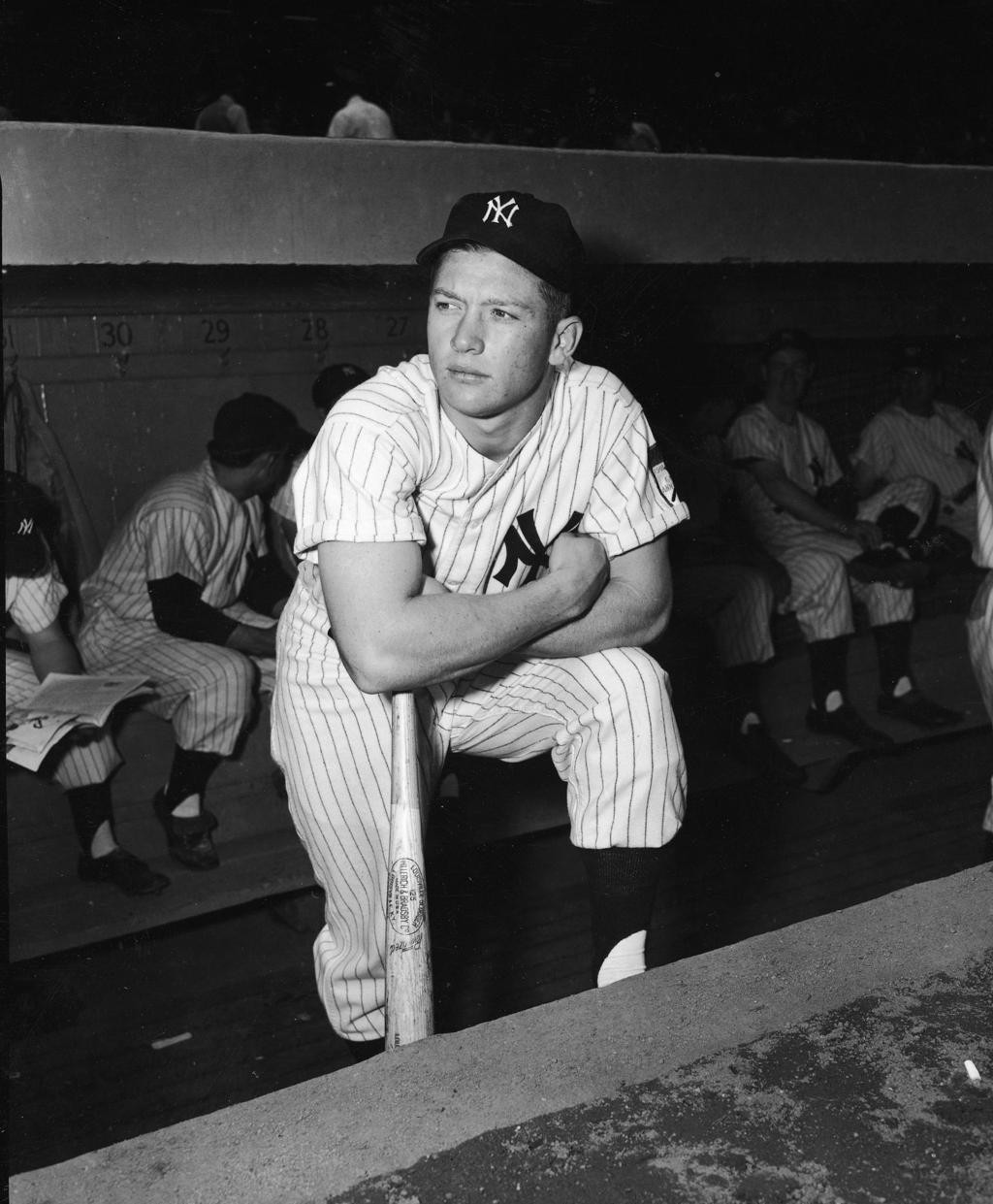
By Bill Coleman
By the time the stadium lights dimmed in the Bronx, another show was just getting started!

The All-American Star Who Didn’t Fit the Mold
On the field, Mickey Mantle was the embodiment of postwar baseball greatness with switch-hitting power, Oklahoma charm and the centerpiece of the New York Yankees dynasty. Off the field, he was something far more complicated: a man sprinting just as hard toward escape as he did toward first base.
Nights That Never Ended

New York in Mantle’s era was a playground, and he didn’t sit on the sidelines. The City’s nightlife—smoky jazz clubs, late-night bars, and celebrity-packed rooms like the Copacabana—became his second home.
Teammates and writers told stories that blurred the line between myth and memory. Mantle could play a full nine innings, then stay out until dawn, only to show up the next day and hit a ball 450 feet. He drank heavily—often, famously—and embraced a lifestyle that ran counter to the clean-cut image baseball tried to project. There were nights when the party followed him, and others when he chased it. Either way, Mantle became a fixture of Manhattan after dark, part athlete, part folk hero, part cautionary tale.
Mantle on Letterman “The Hangover Home Run”
The Brotherhood of the Yankees
Mantle wasn’t alone. The Yankees clubhouse in the 1950s and early ’60s had its share of characters, including the charismatic and controversial Billy Martin. Together, they formed a kind of fraternity—tight-knit, competitive, and often unruly.
Martin, in particular, was Mantle’s running mate in many off-field escapades. Their bond was built on loyalty, mischief, and a shared appetite for pushing limits. The stories—bar fights, late-night antics, and legendary drinking sessions—became part of Yankees lore.
Yet beneath the bravado was a quieter truth: Mantle was often trying to keep pace not just with his teammates, but with his own expectations and insecurities.
Mickey relating a story about Billy Martin
Fame, Pain and Escape

Mantle’s off-field behavior didn’t exist in a vacuum. His body, even in his early 20s, was already betraying him. A devastating knee injury during the 1951 World Series altered the trajectory of his career—and his life.
He played through constant pain, often relying on alcohol as both social lubricant and coping mechanism. The contrast was stark: superhuman on the field, deeply human off it.

Friends would later say that Mantle never quite believed he’d live a long life, a mindset shaped by family history and relentless physical wear. That sense of impermanence fueled a lifestyle that burned fast and bright.

The Myth vs. The Man
By the 1960s, Mantle was more than a ball player; he was a symbol. But the myth often overshadowed the man. Fans saw the home runs; they didn’t always see the toll.
In later years, Mantle spoke candidly about his excesses, expressing regret over the example he set and the strain it placed on his health and family. His honesty added a final layer to his legacy—not just as a hero of the diamond, but as someone who reckoned with his own story.

A Legacy That Endures
Today, Mickey Mantle remains one of baseball’s most compelling figures—not only for what he did between the lines, but for the life he lived beyond them. His off-field adventures are part of the legend. But they’re also a window into the pressures of fame in an era before modern sports science, media training or personal branding.

Mantle didn’t just play baseball. He lived loudly, imperfectly, and unapologetically — leaving behind a legacy as complex as it is unforgettable.

“If I knew I was going to live this long, I’d have taken better care of myself!” Mickey Mantle in late 1994 following his stint at the Betty Ford Clinic and shortly before his death in August 1995.
EXTRA INNINGS!!
Stories of Mantle Drinking Like a Pirate

- For starters, “The Mick” began his days with a big glass of what he called the “breakfast of champions.” It consisted of brandy, Kahlua and cream. Many times he and teammate Billy Martin would walk into Mantle’s restaurant on Central Park South and ordered the drink to kick off a full day of boozing. Mantle told Sports Illustrated in 1994 that the heavy drinking would continue into the afternoon if he didn’t have any business or baseball-related commitments. He said he’d have three to four (not glasses) BOTTLES of wine and didn’t care about the color or quality.
- He and Martin were in Detroit and, after a night on the town, decided to climb the ledge of their hotel room to spy on their neighboring teammates. By the time they realized their lights were off and nothing exciting was going on, they also realized the ledge was too narrow to turn around on. They had to climb around the entire building to get back in their room. Oh, and they were 22 floors high.
- During Martin’s 29th birthday party at the Copacabana night club in New York, Mantle and teammate Hank Bauer were involved in a brawl. Mantle even had to testify in front of a grand jury before the case was thrown out.
- Another time, he and teammate Whitey Ford missed the team bus from Baltimore to Washington D.C. and took a taxi instead. They shared a bottle of scotch along the way and stopped on the side of the road at a fireworks stand. Naturally, they bought some and lit one inside the taxi to scare the driver.
- Bob Costas story from the “MLB Throwbacks” Facebook page states that:
“I had dinner with Mickey one night,” Costas said. “It was in January in New York, and it was really cold. We were walking back to the Regency, where we both were staying, and I had noticed that Mickey had asked for a doggie bag for his dinner in the restaurant–which was sort of strange. Anyway, he asks me to take a walk with him. Now this wasn’t the kind of night where you wanted to take a stroll, but I went along, over to Madison Avenue, where he knew this homeless guy who was in a cardboard box. He knocks on the cardboard and suddenly this guy pops up his head. He looks frightened–and frightening–not knowing who’s there, and suddenly when he sees us, the guy’s face softens. He says, ‘Oh, hi, Mick.’ And Mantle hands him his dinner. It was clear to me he had done this many times before.”
“Did it mean that Mickey was the greatest humanitarian in the world? No–just that that was part of him, just as an hour later he could have been drunk in a bar and told some very nice autograph-seeker to go f_k himself.”
Mantle’s drinking, and the remorse and fear it brought him, haunted him throughout his life. Yet people are rarely defined solely by virtue or vice. Most exist somewhere between those extremes, shaped by a complicated mix of strengths and flaws. Few exemplified this complexity more than Mantle. He was a transcendent talent who, if injuries and an inability to maintain his physical condition had not hindered him, might have been remembered as the greatest player in baseball history. In the end, his demons affected both his life and his career, but they also became inseparable from the legacy of the man the baseball world simply knows as “The Mick.”
LAST CALL!!!
The BJ Letter


Leave a Reply