By Bill Coleman
Ink, Gum, and Caracas Dreams: When Topps Took Baseball Cards to Venezuela
In the late 1950s, as America’s pastime stretched its cultural reach far beyond U.S. borders, one unlikely export followed close behind: the baseball card. For Topps—already the dominant force in the hobby—the decision to produce cards in Venezuela created one of the most fascinating and mysterious chapters in collecting history.
A New Market South of the Caribbean

By 1959, baseball had deep roots in Venezuela. Winter leagues thrived, and Venezuelan stars like Luis Aparicio were making waves in Major League Baseball. Topps saw an opportunity: a passionate fan base, growing U.S. business ties, and a cultural bridge built on baseball.
So began a quiet experiment. Rather than exporting American-made cards, Topps licensed production within Venezuela, creating localized versions of its flagship sets.
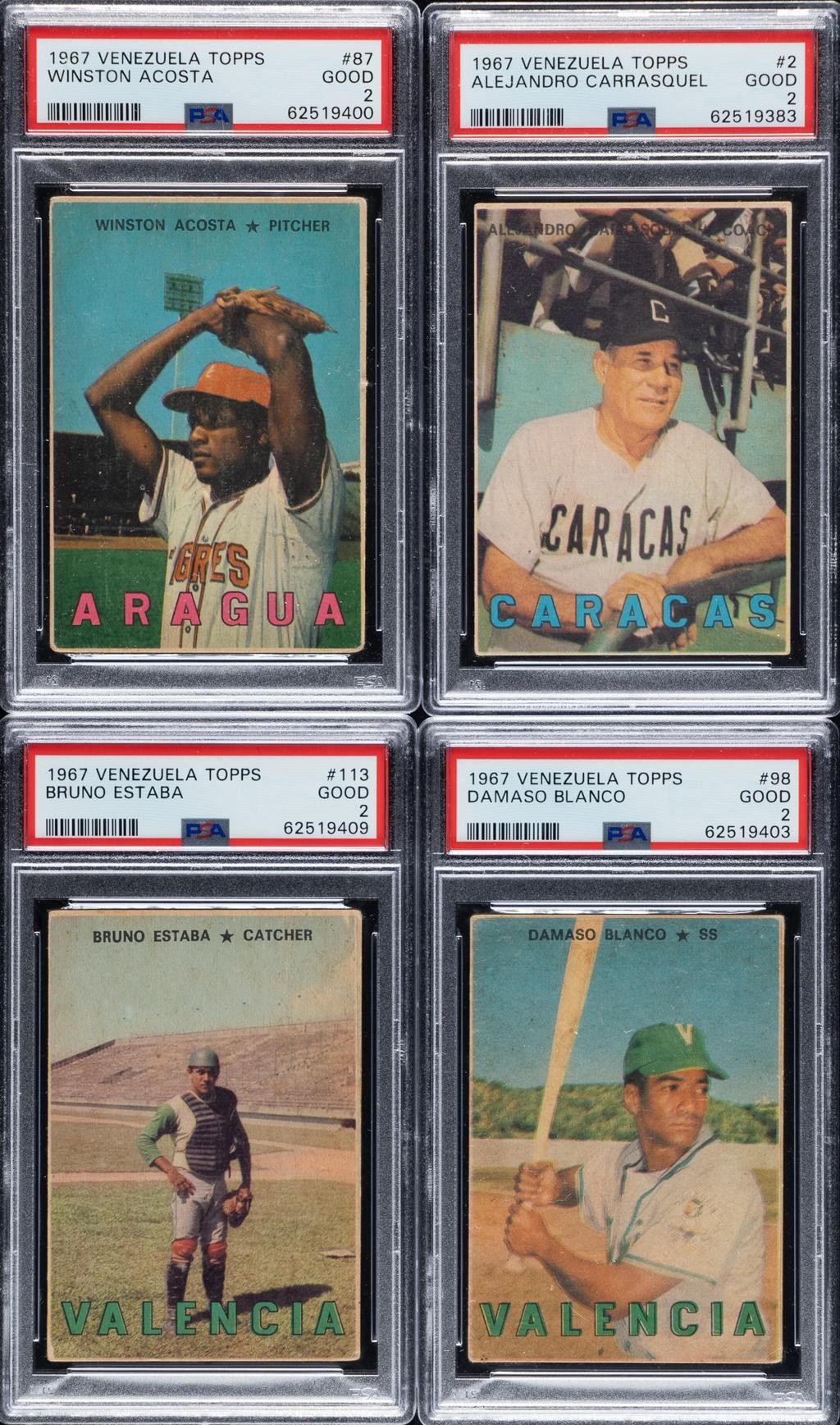
Between 1959 and the late 1970s, Venezuelan Topps sets appeared intermittently—1959, 1960, 1962, 1964, 1966, 1967 and 1968 among the most notable early issues.
Familiar Faces, Different Cards
At first glance, Venezuelan Topps cards looked like their American cousins. The same stars—Mickey Mantle, Willie Mays, Sandy Koufax—appeared on colorful fronts with facsimile autographs and team logos.
But a closer look revealed striking differences:
- Smaller sets: Often just 196–370 cards versus 500+ in the U.S.
- Spanish text: By 1962, card backs were fully translated, reflecting the local audience
- Different dimensions: Some cards were slightly smaller than U.S. versions
- Local printing: Produced by Venezuelan firms rather than Topps’ U.S. factories
These weren’t exports—they were adaptations.
The Rough Reality of Production

If American Topps cards were glossy and durable, their Venezuelan counterparts were anything but.
Collectors today immediately notice:
- Darker, rougher cardboard stock
- Minimal gloss or coating
- Frequent print imperfections
Distribution methods also played a role. Cards were often sold in small packs with gum—or even intended to be pasted into albums.
The result? Most surviving examples are heavily worn, creased or stained. High-grade specimens are exceptionally rare, with even top collections averaging only mid-level condition grades.

Why Venezuela?
The question has lingered for decades: why Venezuela—and not other baseball-loving nations?
The answer likely lies in a perfect storm of factors:
- Rising Venezuelan MLB talent
- Strong U.S. corporate presence (especially oil companies)
- Political stability relative to nearby countries at the time
Meanwhile, Cuba—once a baseball powerhouse—was undergoing a revolution in 1959, making it a far less viable market for American companies.
Venezuela, by contrast, offered both opportunity and accessibility.
From Cheap Gum Inserts to Collector Gold

What were once inexpensive children’s items—sold for just a few centimos per pack—have become some of the hobby’s most elusive treasures.
Today, Venezuelan Topps cards are prized for three reasons:
- Scarcity – Smaller print runs and poor survival rates
- Condition sensitivity – High-grade cards are extraordinarily rare
- Historical intrigue – A unique international branch of Topps history
Collectors often describe them as “parallel sets with personality”—familiar yet unmistakably different.

The Legacy of a Forgotten Experiment
Topps’ Venezuelan venture was never heavily advertised and documentation remains scarce. No confirmed unopened packs have surfaced and much of what is known comes from collectors and fragmented records.
Yet the impact is undeniable.
These cards represent more than a regional variation—they capture a moment when baseball’s global reach intersected with local culture, creating something imperfect, fragile and deeply compelling.
In the end, Venezuelan Topps cards aren’t just collectibles. They’re artifacts of a time when the crack of the bat—and the snap of a wax pack—echoed just as loudly in Caracas as it did in Brooklyn.

Extra Innings!!!
- The highest-paid Topps Venezuelan baseball card is a 1968 Topps Venezuelan Nolan Ryan Rookie Stars card (#177, graded PSA 5), which sold for $100,650. Other notable top-dollar sales for this extremely scarce set include a 1967 Sandy Koufax “Retirado” (#162) for $37,200 and a 1968 Mickey Mantle (#280) for $31,720.
- While Topps most likely had no hand at all in the 1967 Venezuelan set, aside from having their images ripped off, it’s not like Topps was ignoring the rest of the world. As had been the tradition for the previous two years, Topps once again issued an O-Pee-Chee set up in Canada.
- Topps was selling cards in Latin America as far back as 1952. From 1952-1958, the cards were produced in the United States and then shipped for sale to other countries. It was not until 1959 that Topps was not just selling but actually producing cards in Latin America.

Leave a Reply