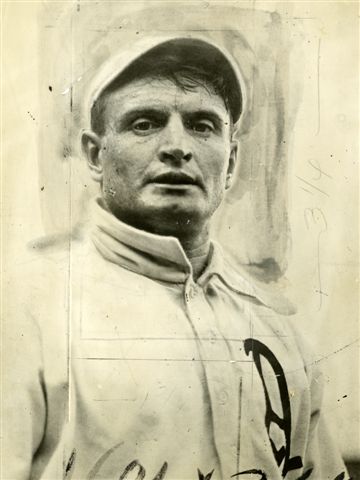
By Bill Coleman
There have been baseball stars. There have been baseball legends. And then there was George Edward “Rube” Waddell, the flame throwing left-hander who may have been the strangest superstar the sport has ever seen.
Author’s Note: “Rube” began as slang for an unsophisticated country bumpkin in the mid-19th century. It was a common nickname for “Reuben,” a popular rural name at the time.
In an age when ball players rode trains, drank hard, and played through injuries that would sideline modern athletes for months, Waddell somehow stood apart from everyone else. He was equal parts genius, circus attraction, folk hero and chaos machine. On the mound, he was nearly unhittable. Off the mound, nobody — managers, teammates, fans or even Waddell himself — knew what he might do next.

Born George Edward Waddell in Pennsylvania in 1876, the pitcher quickly became one of baseball’s first true strikeout artists. In the dead-ball era — when hitters specialized in bunts, slap hits and contact — Waddell overpowered lineups with a blazing fastball and devastating curve. He led the league in strikeouts six straight seasons and posted a career ERA of 2.16. In 1905, he won the pitching Triple Crown by leading the league in wins, strikeouts and earned run average (ERA).

But statistics only tell part of the story. The rest sounds like something invented after too many beers at a sports bar.
Chasing Fire Trucks Mid-Game
Waddell reportedly had an obsession with fire engines. If he heard bells ringing outside the ballpark, he might literally run out of the stadium to chase the fire truck. Stories about him abandoning games to investigate fires became part of baseball mythology.
Managers never knew when disaster might strike. Cornelius McGillicuddy (aka Connie Mack), his longtime manager with the Philadelphia Athletics, once described him as the greatest screwball personality he had ever encountered. Yet Mack also admitted Waddell possessed perhaps the best curveball he’d ever seen.
Opposing fans discovered creative ways to distract him. Some reportedly brought puppies to games because Waddell loved dogs so much he would wander over to pet them during competition. Others waved shiny objects to break his concentration. Amazingly, even distracted, he often still dominated hitters.

Baseball’s Original Showman
Long before sports entertainment became a billion-dollar business, Rube Waddell understood spectacle.
He wrestled alligators in circus sideshows during the offseason. He vanished for months at a time. He sometimes showed up unexpectedly in small towns to pitch for local teams just because it sounded fun. On one occasion, he allegedly left spring training to go fishing.
And despite all of this, he remained one of the most feared pitchers in America.
In 1904, Waddell struck out 349 batters, an astonishing total for the era and a record that stood for decades. He routinely overwhelmed opponents at a time when strikeouts were rare. His strikeout dominance was so extreme that some historians compare him to a dead-ball-era version of Nolan Ryan.

A Brilliant Career Wrapped in Tragedy
Marital problems with his third wife, Madge Maguire, plagued Waddell. He even passed out in the middle of a game against New York in 1909. These incidents led to his release in 1910. He finished the season pitching with Joe McGinnity for Newark in the Eastern League and never played another major league game.
Like many athletes of his era, Waddell battled alcoholism and instability throughout his life. Teammates alternated between admiring him and being exhausted by him. His immense talent made him indispensable, but his unpredictability made him impossible to control. In one often-told story, Waddell helped rescue flood victims during a Kentucky flood and reportedly damaged his health from exposure. Tuberculosis later worsened his condition. He died in 1914 at only 37 years old.
His career stats were 193–143, 2,316 strikeouts and a 2.16 earned run average, with 50 shutouts and 261 complete games in 2,961 innings pitched.
More than three decades later, baseball immortalized him in Cooperstown. Waddell was inducted into the National Baseball Hall of Fame and Museum in 1946.

Why Baseball Still Loves Rube Waddell
Modern baseball is carefully managed, data-driven, and media-trained. Players travel with nutritionists, analysts, and public-relations staffs. That’s one reason Rube Waddell remains so captivating more than a century later. He represents a version of baseball that felt untamed.
He was both elite athlete and wandering folk character, capable of throwing shutouts one day and disappearing into a circus the next. His legend has only grown with time because the stories feel almost impossible to believe.
But that’s the magic of Rube Waddell. The numbers prove he was real. The stories make him unforgettable.

EXTRA INNINGS!!
- The Cracker Clause: Waddell shared a hotel room with his catcher, Ossee Schreckengost. Schreckengost was driven so crazy by Waddell eating animal crackers in bed and dropping crumbs at 3:00 a.m. that he forced their manager to put a clause in Waddell’s contract strictly banning crackers in bed.
- Mid-Inning Fishing: During a minor league game early in his career, he famously abandoned the pitcher’s mound in the middle of an inning because he spotted some kids fishing nearby and decided to join them.
- After a night at an amusement park, Waddell knocked on his manager Connie Mack’s hotel room door at 1:00 a.m. to offer him a “pazzazza” sandwich made of Limburger cheese and stale onions, which Mack declined.
- In 1981, Lawrence Ritter and Donald Honig included him in their book “The 100 Greatest Baseball Players of All Time”. Under what they called “the Smoky Joe Wood Syndrome”, they argued in favor of including players of truly exceptional talent whose career was curtailed by injury (or, in Waddell’s case, substance abuse), despite not having had career statistics that would quantitatively rank them with the all-time greats.


Leave a Reply