By Bill Coleman
For more than a century, Major League Baseball has treated gambling as its greatest threat to competitive integrity. While players have battled performance-enhancing drugs, sign-stealing controversies, and labor disputes, nothing has frightened baseball executives more than the possibility that the outcome of games could be influenced by betting interests.
From the infamous 1919 Black Sox scandal to the modern era of legalized sports betting and smartphone gambling apps, baseball has repeatedly confronted the same question: Can fans trust what they are watching?


Here are the most significant gambling scandals in MLB history.
The Black Sox Scandal (1919): Baseball’s Original Sin

No gambling story has shaped baseball more than the 1919 World Series. Eight members of the Chicago White Sox were accused of conspiring with professional gamblers to intentionally lose the World Series to the Cincinnati Reds in exchange for cash payments. Among those implicated were stars Eddie Cicotte, “Shoeless” Joe Jackson and Buck Weaver.

Although several players were acquitted in court, baseball’s newly appointed commissioner at that time, Judge Kenesaw Mountain Landis, permanently banned all eight players from organized baseball. The message was unmistakable: “Regardless of the verdict of juries, any player who throws a ball game will never play professional baseball again.”

Eddie Cicotte (1884–1969)
After being banned from baseball in 1921, Cicotte returned to Michigan and largely withdrew from public life. He worked for the Ford Motor Company and later raised strawberries on a small farm near Farmington, Michigan. Friends and neighbors described him as quiet and hardworking. In interviews late in life, Cicotte admitted he had made a terrible mistake and said he had spent decades trying to live an honorable life afterward. He died on May 5th, 1969, at age 84 from complications following a stroke and was buried in Livonia, Michigan.
“Shoeless” Joe Jackson (1887–1951)
Jackson never stopped insisting that he had played his best during the 1919 World Series, despite accepting money connected to the scandal. A claim that remains one of baseball’s most hotly debated controversies. After his ban, he continued playing semipro baseball under assumed names for many years. Eventually he and his wife, Katie, settled in Greenville, South Carolina, where they operated a liquor store and later a restaurant. Fans frequently stopped by hoping to meet the legendary hitter. Jackson suffered from heart problems in his later years and died of a heart attack on December 5th, 1951, at age 64. He never lived to see his ban lifted nor received Hall of Fame consideration.
Buck Weaver (1890–1956)
Unlike Cicotte and Jackson, Weaver always maintained that he never accepted money to throw the World Series. His lifetime ban resulted from knowing about the fix and failing to report it. Weaver spent much of the next three decades working in construction, operating a cleaning business and later supervising athletic facilities in Chicago. He repeatedly petitioned baseball commissioners for reinstatement, arguing that while he had remained silent, he had played the Series honestly. Every appeal was denied during his lifetime. Weaver died of a heart attack on January 31st, 1956, at age 65, still hoping baseball would someday forgive him.
A Posthumous Epilogue
For more than a century, all three men remained on Major League Baseball’s permanently ineligible list. In May 2025, Commissioner Rob Manfred ruled that permanent ineligibility ends upon a person’s death, removing Jackson, Cicotte, Weaver and the other deceased Black Sox players from the banned list. That decision made them eligible to be considered by the Baseball Hall of Fame’s Classic Baseball Era Committee, though election is still not guaranteed.
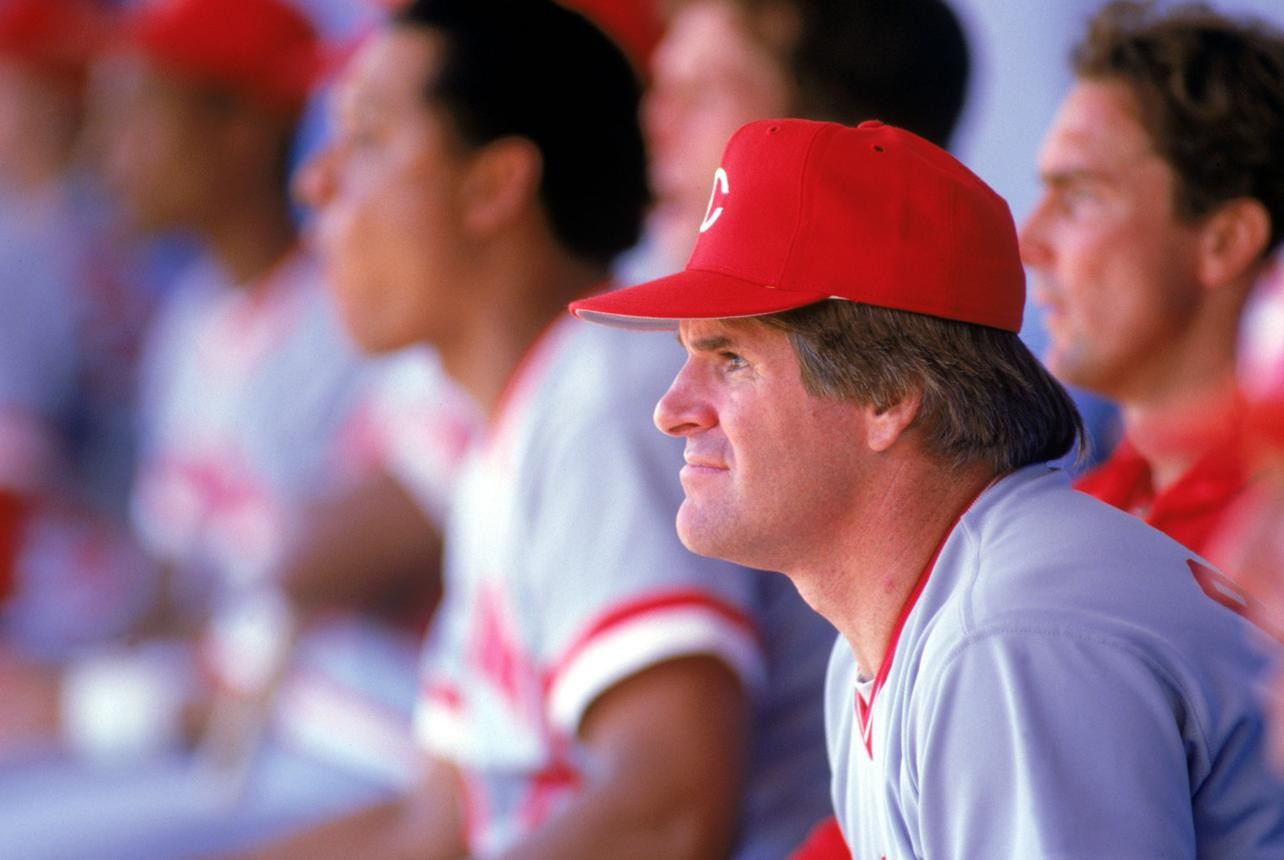
Pete Rose: Baseball’s Greatest Hit King Falls

No gambling case has generated more debate than Pete Rose’s. Rose collected an all-time record 4,256 hits and appeared destined for Cooperstown before an investigation concluded he had bet on baseball while managing the Cincinnati Reds. Crucially, investigators found evidence that Rose wagered on games involving his own team, although they did not conclude that he bet against the Reds. Rose accepted a permanent place on baseball’s ineligible list in 1989.

After being permanently banned, Rose spent decades trying to gain reinstatement. Although he admitted in 2004 that he had bet on baseball—including Reds games while serving as manager—MLB commissioners consistently denied his requests to have the lifetime ban lifted. Because of the ban, he remained ineligible for the National Baseball Hall of Fame.
Despite his exile from Major League Baseball, Rose remained a popular figure with many fans. He became a regular on the sports memorabilia and autograph-show circuit, where long lines often formed for his signature. He also made occasional television appearances and worked as a baseball analyst. In 2016, the Cincinnati Reds inducted him into their Hall of Fame, and the Reds increasingly welcomed him back to Great American Ball Park for special events, where he received enthusiastic ovations.
Rose continued making public appearances into 2024. On September 30, 2024, he was found dead at his home in Las Vegas, Nevada, at the age of 83. The Clark County Coroner determined that he died of natural causes related to hypertensive and atherosclerotic cardiovascular disease, with diabetes mellitus listed as a contributing factor.
In the aftermath of his death, tributes poured in from former teammates, opponents and fans. Others reflected on the contradiction that defined his legacy: baseball’s all-time hits leader with 4,256 career hits and three World Series championships, yet permanently banned from the game because of gambling. As noted with the Black Sox players above, Rose’s death resulted in his removal from the banned list. However, his Hall of Fame enshrinement is still not guaranteed.

The Modern Betting Era: Tucupita Marcano
In June 2024, MLB permanently placed Tucupita Marcano on the permanently ineligible list after an investigation found he had placed 387 baseball bets totaling more than $150,000 between October 2022 and November 2023. Twenty-five of those bets involved Pittsburgh Pirates games while he was on the Pirates’ injured list. MLB stated there was no evidence that any games were manipulated or compromised, but Rule 21 mandates a lifetime ban for betting on games involving your own club.

Because his ban applies to MLB and its affiliated minor leagues, he was free to pursue opportunities in independent baseball. The Fargo-Moorhead RedHawks, who are not affiliated with MLB, signed him before the 2026 season. Marcano is also eligible to play winter baseball in Venezuela, as the Venezuelan Winter League is not bound by MLB’s permanent ineligibility rules.


At just 26 years old, Marcano’s professional playing career has continued outside MLB, but unless Commissioner Rob Manfred (or a future commissioner) grants reinstatement, he remains permanently ineligible for Major League Baseball.
The Interpreter Scandal That Shook Baseball

Ippei Mizuhara, Shohei Ohtani’s longtime interpreter and close confidant, stole just under $17 million from Ohtani’s bank account over a period from late 2021 through early 2024. Federal investigators determined that Mizuhara exploited the trust Ohtani placed in him. Because he had helped Ohtani establish his US bank account and frequently handled translation and business matters, he was able to:
- Change the bank’s security settings so that his own phone number was used for authentication.
- Impersonate Ohtani during phone calls with the bank to authorize wire transfers.
- Transfer nearly $17 million from Ohtani’s account to pay off mounting debts to an illegal Southern California bookmaker.
- Used additional stolen funds for personal expenses, including purchasing approximately $325,000 worth of collectible baseball cards and dental bills.
Investigators found that Mizuhara placed roughly 19,000 sports bets over about two years, losing approximately $41 million overall. Authorities stated there was no evidence he bet on Major League Baseball, and they concluded that Ohtani was a victim, not a participant in the gambling scheme.
The scandal became public in March 2024, when the Dodgers were in South Korea for the season-opening series. Mizuhara initially claimed Ohtani had knowingly paid his gambling debts, but he quickly retracted that story. Federal investigators later determined Ohtani had no knowledge of the thefts and had never authorized the transfers.
Mizuhara was subsequently fired by the Los Angeles Dodgers as well as charged with bank fraud and filing a false tax return. He pleaded guilty in June 2024. In February 2025, a federal judge sentenced Mizuhara to four years and nine months in a federal prison; three years of supervised release after prison; $17 million in restitution to Shohei Ohtani; and $1.1 million in restitution to the IRS for unpaid taxes on the stolen money.
He surrendered to federal authorities in June 2025 and began serving his sentence at a federal prison in Pennsylvania. Because he is a Japanese citizen, he is also expected to face deportation proceedings after completing his prison term. The case is widely regarded as one of the largest financial betrayals ever committed by a personal employee against a professional athlete, not only because of the $17 million stolen but also because Mizuhara had been one of Ohtani’s closest companions since his arrival in the US in 2018.
Investigations found no evidence that Ohtani bet on baseball or knowingly participated in the scheme. Instead, authorities concluded that Mizuhara had committed extensive bank and wire fraud while concealing his actions from Ohtani.
(See ESPN’S 30 for 30 YouTube podcasts on “The Betrayal of Shohei Ohtani”, released on July 28th, 2026, in the “Extra Innings!!!” section below,)
Why Baseball Is So Strict?
Unlike many sports, baseball’s Rule 21 has long warned players and team personnel that betting on baseball carries the sport’s harshest penalties.
The reasons are straightforward:
- A single compromised player can influence an entire game.
- Public confidence depends on believing every contest is honest.
- Gambling scandals can permanently damage the sport’s reputation.
The warning signs are posted prominently in every Major League clubhouse.
Could Another Black Sox Happen?
Today’s baseball looks very different from 1919. Advanced data tracking, video review, integrity monitoring, legalized sportsbooks and cooperation with betting companies make it far easier to detect suspicious wagering patterns than it was a century ago.
Yet the explosion of legal sports betting has also made placing wagers easier than ever, creating new challenges for players and league officials. As MLB continues to embrace sportsbook partnerships while maintaining one of professional sports’ toughest anti-gambling policies, the balance between business opportunities and competitive integrity remains one of the game’s most delicate issues.
The Legacy
Every generation of baseball has faced its own gambling controversy. Whether it was the Black Sox secretly fixing a World Series, Pete Rose risking his legendary legacy or modern players violating betting rules with a smartphone, each scandal has reinforced one enduring lesson: For Major League Baseball, protecting the integrity of the game has always outweighed protecting even its biggest stars.
Extra Innings!!!
ESPN’S 30 for 30 Podcasts: “The Betrayal of Shohei Ohtani” Episodes 1 & 2
Leave a Reply